“Villager artist Joseph Papin imagines a New Year’s Eve Brotherhood Ball at which couples will include (l to r) Anthony Dapolito and James J. Kirk; a ‘Big Builder’ and Arnold H. Bergier; a ‘Beatnik’ and Louis H. Solomon; (below) Carmine G. DeSapio and Charles E. McGuinness; and Raymond S. Rubinow with Commissioner Robert Moses.”
(Note that the following drawings are photographed from the newsprint and the lines have filled in a bit from the printing process.)
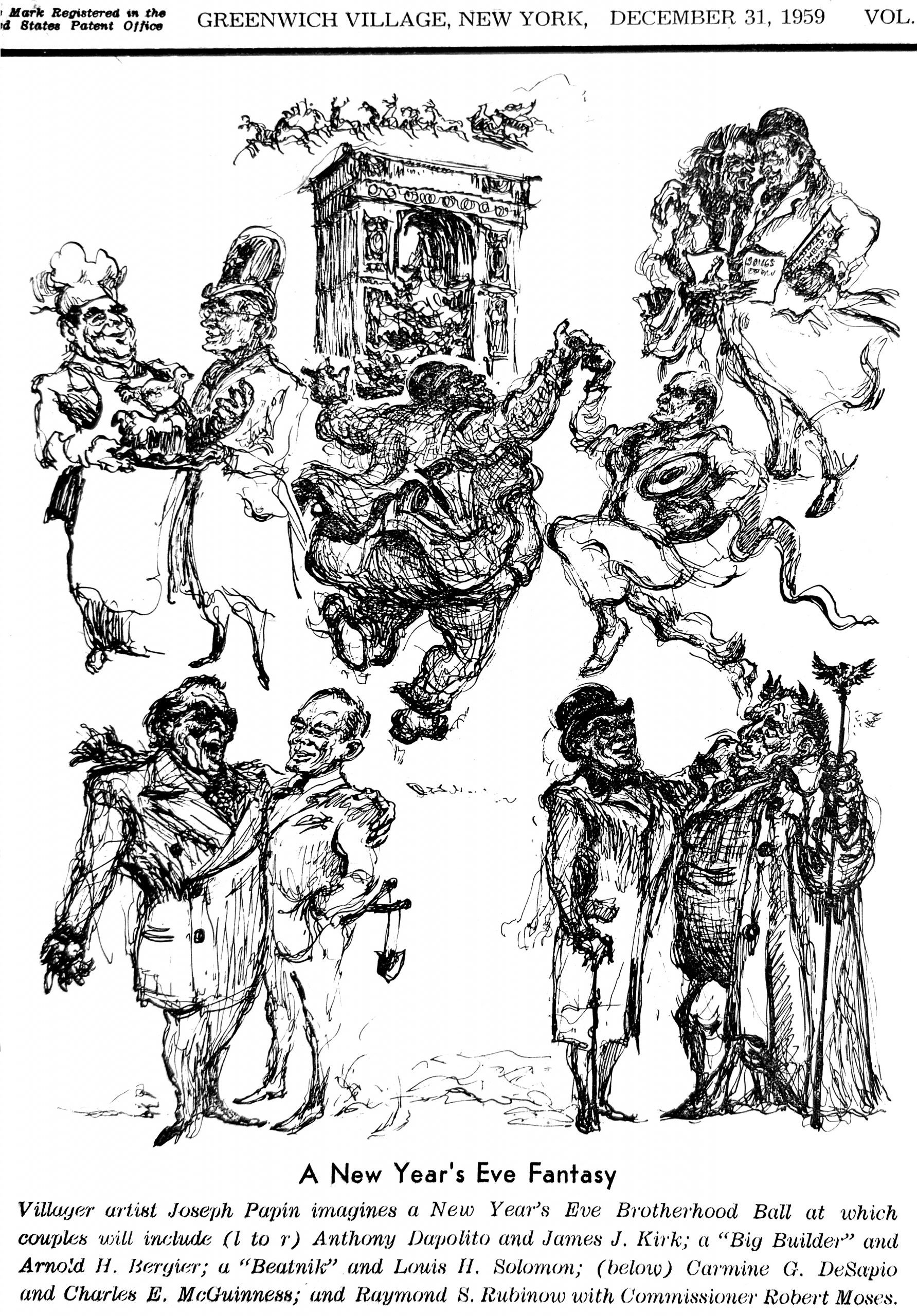
Looking at the different characters in each of the five drawings:

“Anthony V. Dapolito (1920-2003), a long-time chair of Community Board 2, whose roots in the community and tireless work on its behalf earned him the honorary title, ‘Mayor of Greenwich Village.’ In 1920, shortly after he was born, Dapolito’s family opened the Vesuvio Bakery on Prince Street. Over the years, he progressed from making bread deliveries to owning the family business and ultimately becoming a highly respected community leader.” (https://www.nycgovparks.org/…/tony…/highlights/6422)
James J. Kirk, American Legion, Officer of the Tamawa Club, was a Tammany Democrat (as opposed to the Village Independent Democrats). “At its peak, Tammany Hall also played a major role in state and national politics, particularly during the Gilded Age, when New York was sharply contested as a swing state, and it hosted the 1868 Democratic National Convention. Its positions typically represented the interests of its immigrant, ethnic, and Catholic voter base, in addition to the personal interests of its leadership. …The Tammany Hall organization was also a frequent vehicle for political graft, most famously during the leadership of William M. Tweed, whose 1873 conviction for embezzlement gave the organization its national reputation for corruption.” (https://en.wikipedia.org/wiki/Tammany_Hall)
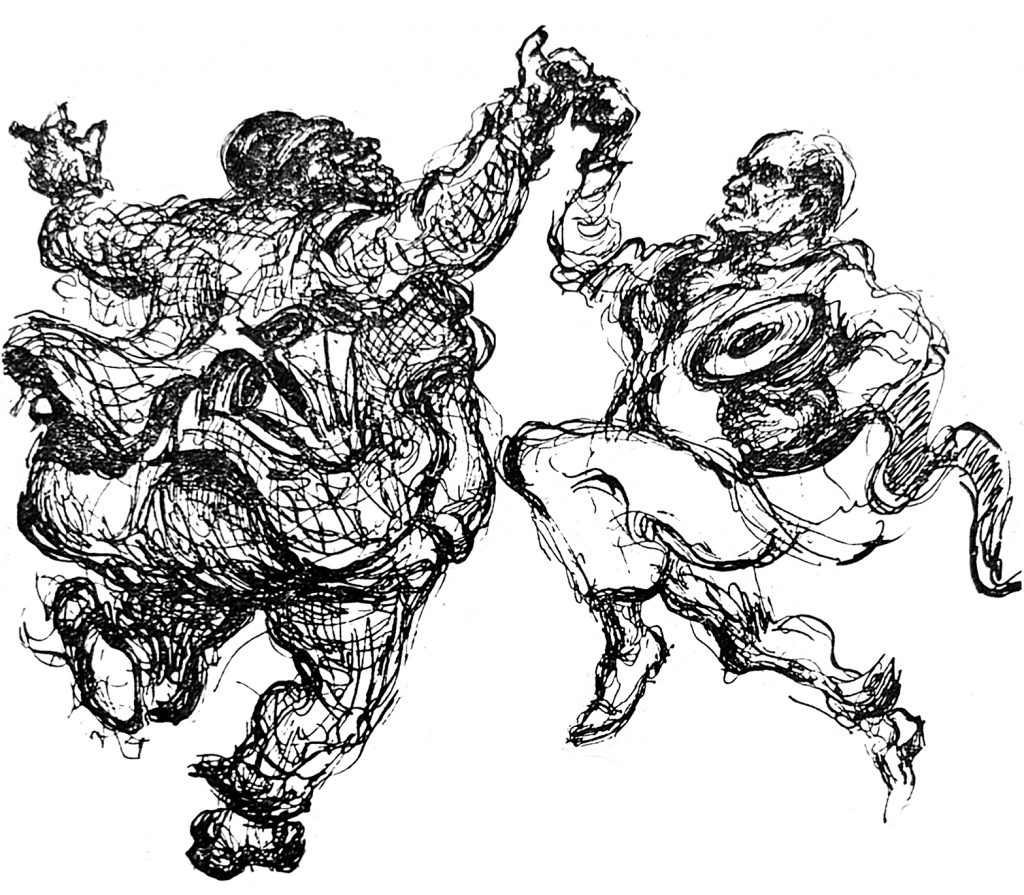
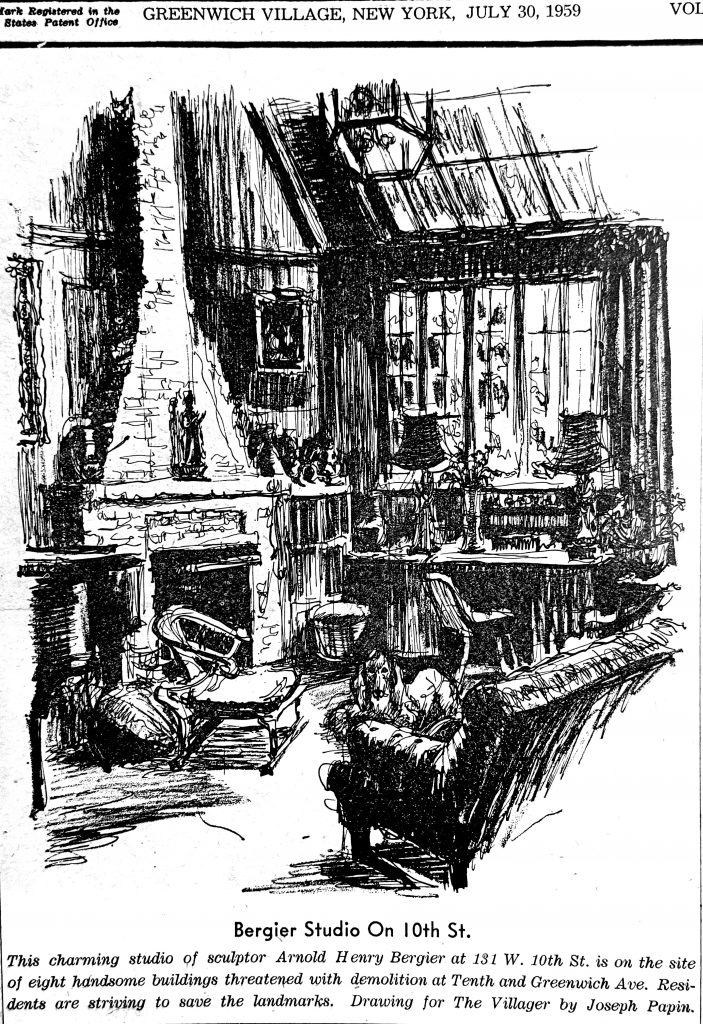
This drawing of “Big Builder” and Arnold Bergier reflects back to Joseph Papin’s drawing five months earlier on July 30, 1959 (below).
“Bergier Studio On 10th St.”
“This charming studio of sculptor Arnold Henry Bergier at 131 W. 10th St. is on the site of eight handsome buildings threatened with demolition at Tenth and Greenwich Ave. Residents are striving to save landmarks. Drawing for The Villager by Joseph Papin.”
The Arnold H. Bergier was “an artist who lived and worked in the Village in a studio on Greenwich Ave. at W. 10th St. [and] helped organize a group of neighbors who fought a wave of evictions and high-rise development. Save the Village, chaired by Arnold Bergier, appeared at City Planning Commission and City Council meetings demanding new zoning to protect the low-rise character of the Village. ‘He was a very good public speaker,” said Doris Diether, also a founding Save the Village member. ‘He had a wonderful studio with a two-story atrium but he lost it in 1960 when a developer demolished it to build the high-rise that’s there now,’ Diether recalled.” (The Villager, January 30, 2007, found on https://www.amny.com/…/arnold-bergier-92-artist…/).
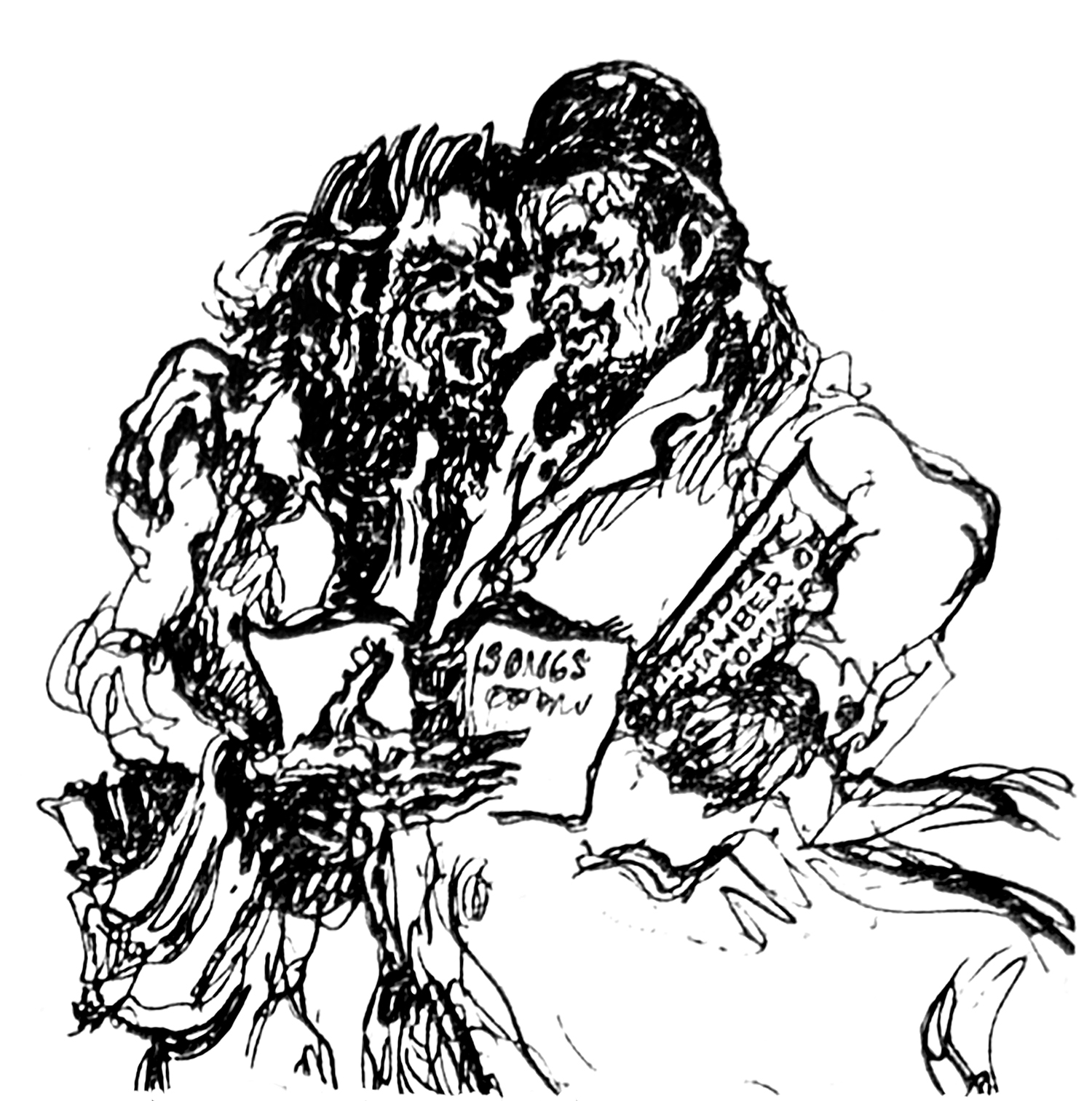
Beatnik and Louis H. Solomon
“The use of mind-altering substances runs through the history of the Beats, who tried to expand consciousness by using drugs. Many were vocal advocates for the legalization of drug use, and at times victims of addiction. Inspired, in part, by the prominence of marijuana in 1940s jazz culture, the Beats went on to explore psychoactive plants such as peyote and newly introduced synthetic compounds such as LSD. Allen Ginsberg was an early experimenter with hallucinogenic drugs in the 1950s. He later became friendly with Timothy Leary and Ken Kesey, connecting the Beats with the “turned-on” psychedelic youth culture of the 1960s. William S. Burroughs struggled with a longtime heroin addiction that became the subject of much of his writing; he also dispassionately explored the short- and long-term effects of a vast range of drugs.” (https://exhibitions.lib.udel.edu/beat-visions-and-the-counterculture/drugs-and-the-counterculture/)
“Greenwich Village in the late 1950s and early 1960s is a particularly illuminating case study [regarding opioid addiction]. Community leaders Reverend Howard Moody of Judson Memorial Church and Village Voice publisher Ed Fancher raised awareness about the suffering of heroin users and addicts. They excoriated the dominant punitive approach in narcotics policy and advocated socio-medical treatment methods instead. …Except for some ministers and social workers, who came into close contact with addicts, local leaders either ignored the problem or advocated punitive sanctions. For instance, Assemblyman William Passannante, a South Village native himself, proposed legislation in Albany several times in the mid-1950s that would have made addiction a criminal offense. Attorney Louis Solomon, President of the Greenwich Village Chamber of Commerce, championed stronger legal enforcement.” (https://www.gothamcenter.org/…/greenwich-village-fights…)
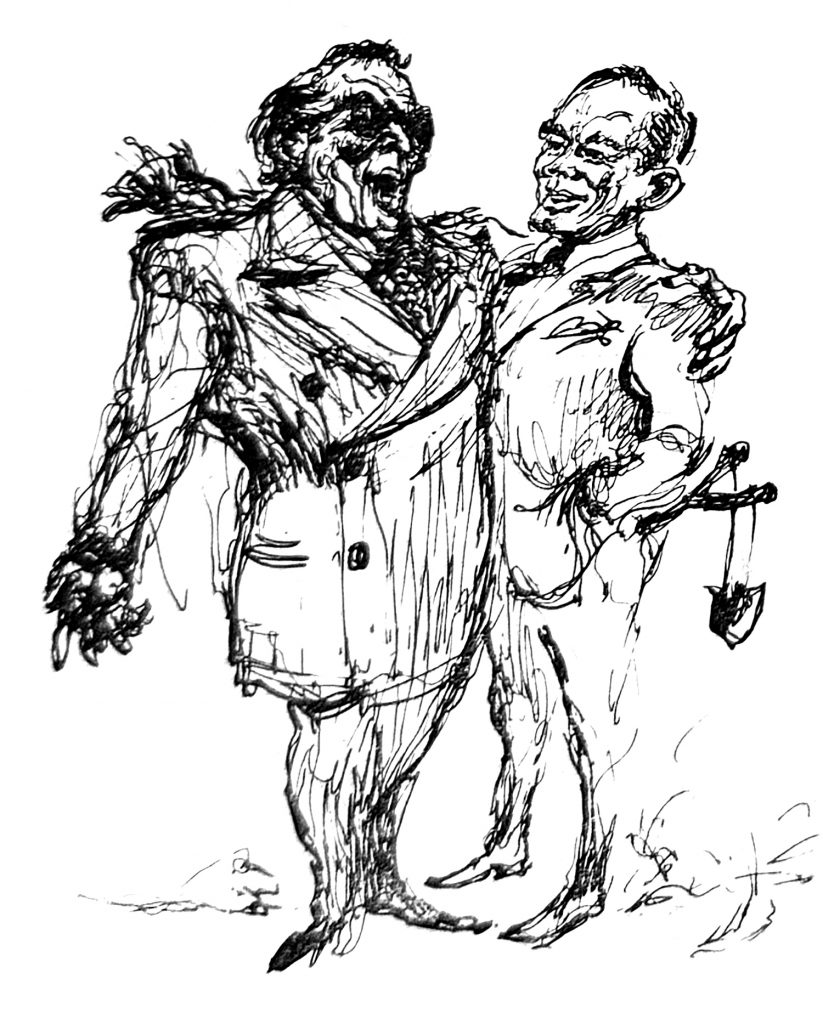
Charles E. McGuinness and Carmine G. DeSapio:
“The Village Independent Democrats last night named Charles E. McGuinness as its candidate to oppose Carmine G. DeSapio for the leadership of the First Assembly District South. Mr. McGuinness, a 38-year-old lawyer, will run against Mr. DeSapio, the New York County Democratic leader, in the September primaries. ‘I think the people have become aware of the true DeSapio nature for one-man rule, ‘ Mr. McGuinness said. ‘This election,’ he pledged, ‘will afford the people an opportunity to destroy the symbol of political bossism once and for all.’ “ (New York Times, March 13, 1959). McGuinness lost to DeSapio by less 600 votes and paved the way for DeSapio’s subsequent defeat.
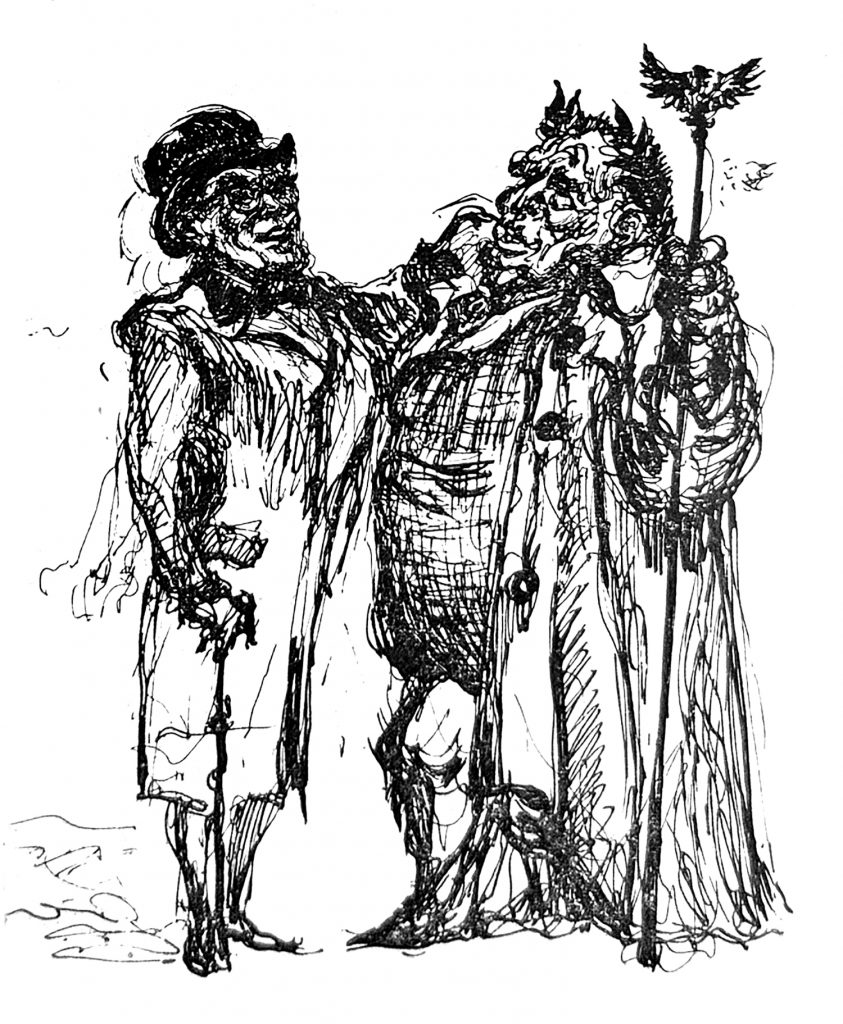
Robert Moses:
“In 1935, the Parks Department under Commissioner Robert Moses proposed a comprehensive renovation that would have completely destroyed [Washington Square] park’s integrity as a neighborhood green. In proposing a plan before consulting the local population, Moses, the invincible ‘power broker,’ unwittingly launched a movement of tenacious civic activism. Each of the successive plans only served to strengthen the neighborhood’s resistance. It became clear that the Commissioner’s goal was to cut a major roadway through the Square to connect Fifth Avenue with lower Manhattan, where he was planning an east-west crossing that would have destroyed the cast-iron district of Soho as well as sections of the old Village.
“The interrelated issues of the park’s redesign and traffic in and around the Square continued to plague the neighborhood. Through three decades, committed and canny residents, wise in the ways of organizing and using the press, jousted with Moses and an array of city planners and officials, finally achieving victory in 1958. Ultimately, Greenwich Village was the only community to have vanquished Robert Moses. The park grounds were to be left as they were, and for the first time since the Parks Department had taken it over in 1870, Washington Square was traffic-free.” (washingtonsqpark. org/history).
(Note that the drawing at the very top of the montage shown first is a drawing of the Washington Square Arch in Washington Square Park Greenwich Village, New York.)
The following addressed why Robert Moses is dressed in Shakespearean costume as well as Raymond S. Rubinow:
“Mediation of the dispute over free Shakespearean performances in Central Park was suggested yesterday by the newly formed We Want Will Committee.
“Raymond S. Rubinow, chairman of the committee, said that it was willing to name a group of prominent citizens to help end the dispute between Park Commissioner Robert Moses and Joseph Papp, producer.
“Mr. Rubinow offered the committee’s services if negotiations begun last week by Justice Samuel M. Gold failed.
“Mr. Moses has refused to issue a permit for the Shakespeare Festival this summer.
“An action to compel Mr. Moses to issue the permit is pending in State Supreme Court. Mr. Moses is in Bermuda on a brief vacation.” (New York Times, May 25, 1959).
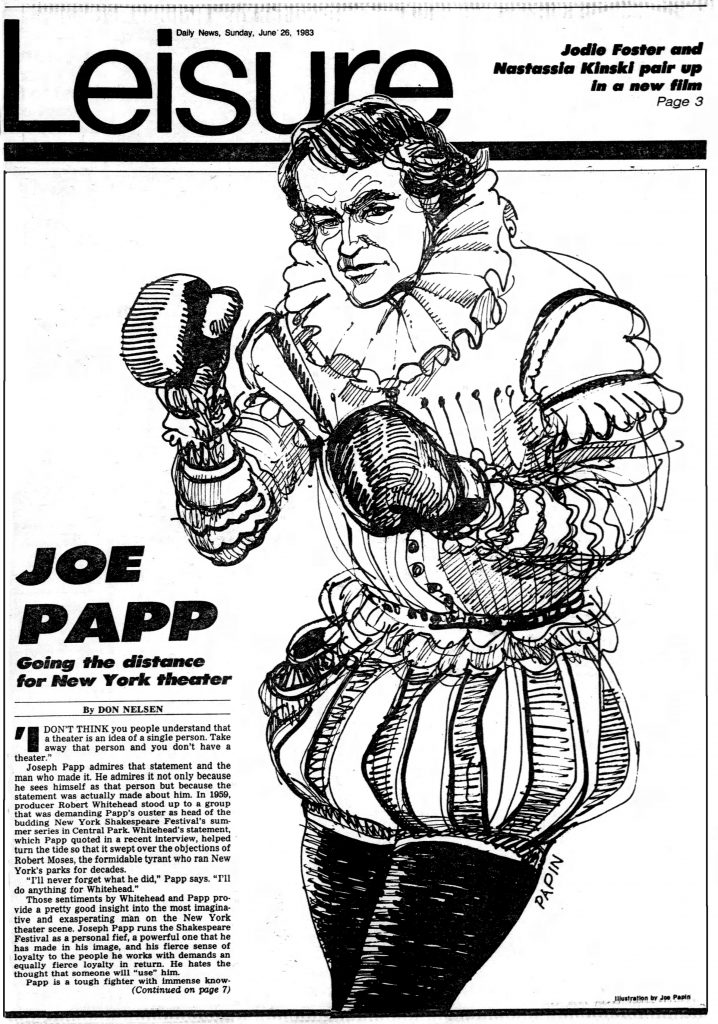
“Joe Papp pitches a battle with Parks Commissioner Robert Moses who seeks to end free admission to performances in the park. After two successful free seasons of plays in the park, Moses claims that theater goers trample the grass and Papp should charge admission to pay to have the grass replanted. A group of citizens with the support of actress Helen Hayes, launches the ‘We Want Will Committee,’ as public support for Papp and the idea of free Shakespeare begins to grow. Eventually it’s revealed that the real reason behind Moses’ attempt to force Papp to charge admission to his Shakespeare productions is Papp’s political past which becomes clear when Moses leaks word to the press that Papp is a Communist. After losing in the court of popular opinion, Moses who initially wins in court, loses on an appeal. Judge J. McNally rules that the Park Commissioner [Robert Moses] acted in a manner considered ‘arbitrary, capricious and unreasonable.’ This victory catapults Papp into the public limelight and launches the NY Shakespeare Festival as a major cultural institution. Following the court’s ruling in Papp’s favor, Robert Moses requests funds from NYC’s Board of Estimate (governmental body previously responsible for budget and land-use decisions) to build a Shakespeare-style amphitheater in Central Park.” (www.pbs.org/wnet/americanmaster/Joe-Papp-biography-and-life-timeline).
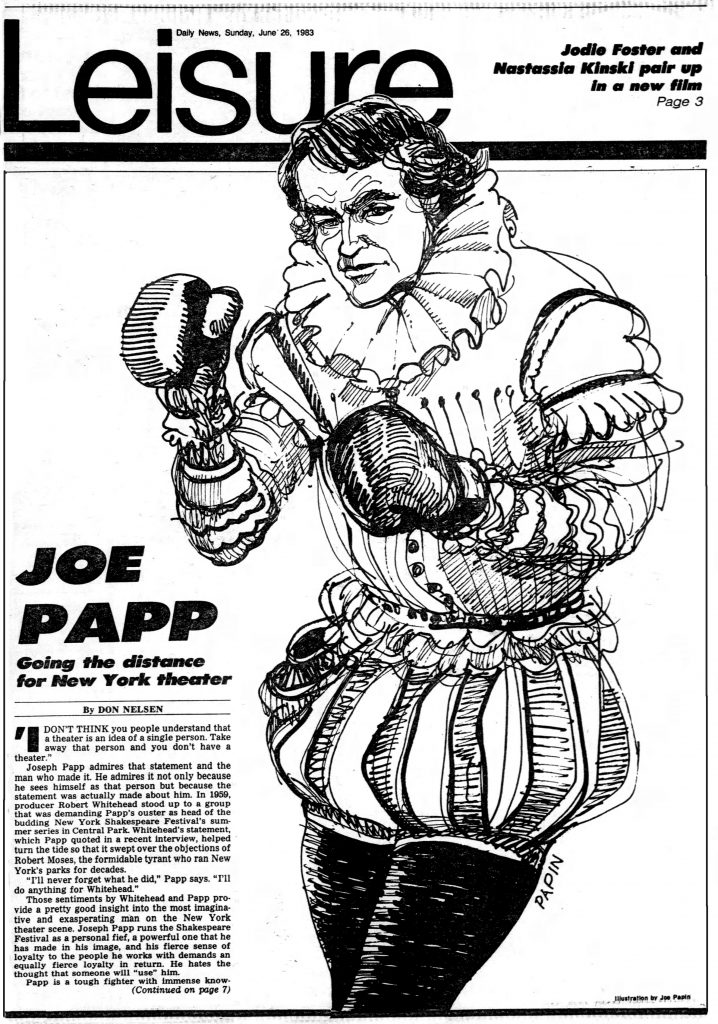
Joseph Papin drew Joseph Papp for the June 26, 1983 Daily News Leisure section which references Joseph Papp’s conflict with Robert Moses:


Leave a Reply